

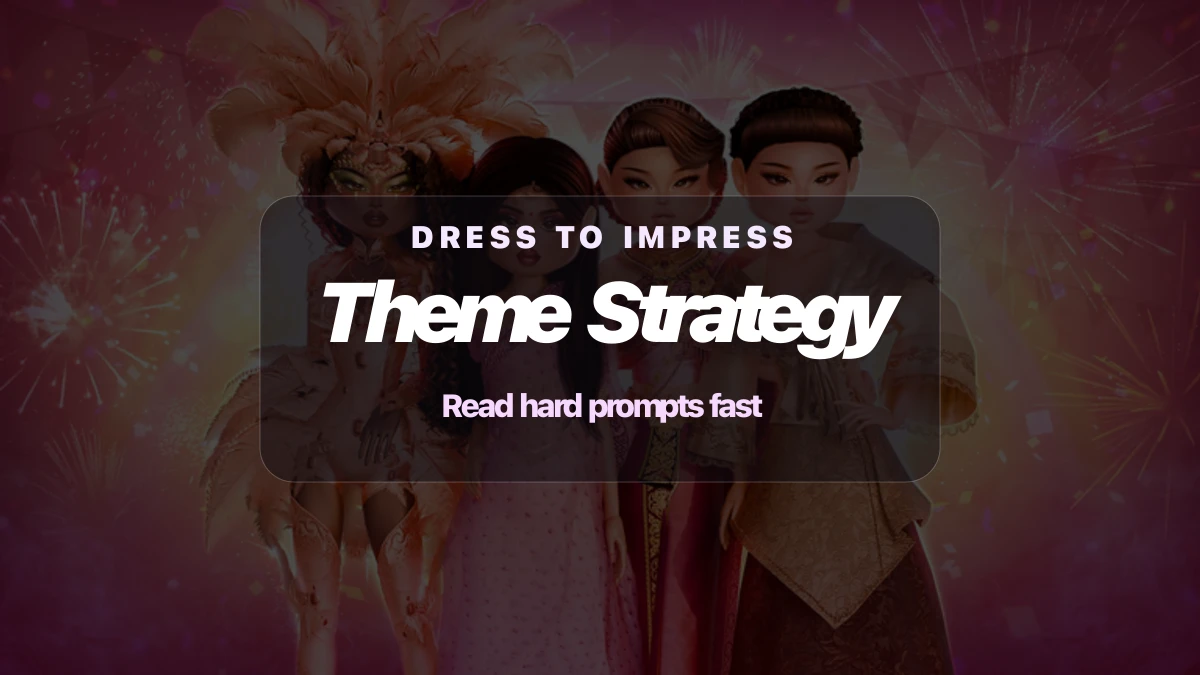
Dress To Impress themes get harder when you treat the prompt like a trivia question. A better move is to turn the word into an outfit job: what kind of prompt is it, what shape proves it, what palette sells it, and which one clue makes the idea obvious on the runway.
The Dress To Impress themes list is the row-by-row lookup for exact meanings. This strategy is for the round itself, when the timer is moving and you need a clear outfit direction before you start clicking every pretty item you own.
Start by naming the prompt type
Most hard themes become easier once you stop asking, "What is the perfect outfit?" and start asking, "What kind of instruction is this?" A color prompt, a job prompt, and an aesthetic prompt need different first choices. If you identify the type early, you waste less time trying random clothes.
| Prompt type | What it wants | Fast first move |
|---|---|---|
| Color, pattern, or material | A dominant visual idea | Make the color, print, shine, lace, denim, gold, or texture visible before small accessories |
| Job, school, or role | A believable person or uniform | Pick one role, then add glasses, ties, bags, hats, aprons, badges, or neat layers that explain it |
| Aesthetic or fashion style | A recognizable style language | Copy the palette, silhouette, hair, makeup, and accessory mood for that style |
| Character, celebrity, or media | One readable reference | Choose one character or performer and copy their strongest colors, hair, outfit shape, or prop |
| Fantasy, spooky, or royal | A character silhouette or mood | Build the shape first, then add wings, crowns, capes, masks, dark makeup, sparkle, or nature details |
| Duo, versus, or group | A side, pair, or contrast | Choose your side early and make the color or role contrast obvious |
| Food, object, or abstract idea | A visual translation | Turn the idea into colors, symbols, shapes, or one playful accessory theme |
That first label does not need to be perfect. It only needs to point your outfit in one direction. If the prompt is Teacher, you can start with a school/work role. If it is Dripping in Gold, make gold the outfit's main event. If it is Angels vs Devils, choose one side before you touch hair or makeup.
Build the outfit around four anchors
A readable outfit usually has four anchors: silhouette, palette, texture, and one runway clue. Silhouette is the big shape voters see first. Palette is the color story. Texture or pattern adds style. The clue is the detail that proves your interpretation.
For Cowboy, the silhouette might be western shirt plus pants or skirt, the palette might be denim and brown, the texture might be leather or fringe, and the clue is a hat or belt. For Fairy, the silhouette can be soft and floaty, the palette can be pastel or forest colors, the texture can be sparkle or floral layers, and the clue is wings. For 1920s/Roaring 20s, the shape, pearls, gloves, feathers, black, and gold all do more work than piling on random glam pieces.
Use the anchors in order. A strong accessory cannot rescue an outfit that has the wrong shape and color. A clean silhouette and palette can still read well even if your wardrobe is missing the perfect prop.
Hard aesthetic prompts need translation first
Aesthetic prompts are tough because the word itself may be unfamiliar. Do not build from the name alone. Translate it into colors, layers, hair, and mood, then keep the outfit restrained enough for voters to recognize the style.
| Hard prompt | Fast read | Safe outfit anchors |
|---|---|---|
Acubi | Minimal Korean streetwear with muted colors and slim layers | Gray, black, white, fitted layers, belts, headphones, simple shoes |
VKEI | Japanese rock styling with dramatic hair and dark stagewear | Black, red, boots, chains, lace, bold makeup, sharp layers |
Mori Kei | Soft forest-girl styling | Cream, brown, green, layered skirts, cardigans, lace, florals |
Douyin | Polished social-media glam | Sleek hair, fitted dress or set, soft pink or white, delicate jewelry |
Whimsygoth | Dreamy gothic romance with celestial details | Black, purple, velvet, lace, moons, stars, mystical accessories |
Decora | Bright Harajuku style with cute accessory overload | Rainbow colors, hair clips, bows, bracelets, playful layers |
Gyaru | Bold Japanese glam styling | Big hair, strong eye makeup, animal print, boots, bright accessories |
The trick is to copy two or three strong cues, then stop. Decora can handle a lot of accessories because that is the point. Acubi usually works better with clean layers and muted colors. If every hard aesthetic becomes the same pink glam outfit, the theme read disappears.
Ambiguous themes need one confident version
Vague prompts punish hesitation. If a theme has many valid answers, pick one and make it obvious. Dream Job can be doctor, singer, designer, teacher, detective, chef, or anything else, but the runway only sees the version you choose. A clear doctor outfit beats a confusing mix of doctor coat, pop-star hair, and random wings.
Use these rules when the prompt feels too open:
- For
Favorite Color, commit to one main color family. Add shade variety, shine, or pattern instead of switching to several unrelated colors. - For
Dream JoborFuture Career, choose one job and show the uniform, tool, or work setting. - For
Favorite Movie,Favorite Show, orFamous Singer, pick one recognizable reference and copy its strongest hair, palette, or outfit shape. - For
Emotions, choose one mood and let color and makeup carry it. Sad, angry, joyful, and mysterious all need different palettes. - For
Food-inspired, use color, shape, and playful accessories. Strawberry, chocolate, lemon, sushi, or coffee should each look different from the runway. - For
Freestyle, make your own theme internally. Decide on glam, spooky, casual, fantasy, or Y2K before dressing so the outfit still has a reason.
Ambiguous does not mean random. It means you get to choose the answer, then you have to sell that answer clearly.
Versus themes need a clear side
Versus prompts work best when you choose a side early. Angels vs Devils, Fire vs Ice, Pirates vs Sailors, Popstars vs Rockstars, and Detective vs Suspect all invite contrast. If you try to wear both sides at once, the outfit can turn muddy unless you are intentionally making a split look.
For solo rounds, pick the side with the strongest wardrobe pieces you can build fast. Angel can lean white, gold, wings, soft hair, and glowing makeup. Devil can lean red, black, horns, sharp silhouettes, and dramatic makeup. Detective can use coats, hats, glasses, and dark neutrals. Suspect can look shadier with darker colors, masks, messy layers, or stolen-looking accessories.
If you are playing with a friend, coordinate opposite sides. If you are alone, make your side so clear that voters do not need to guess which half of the prompt you chose.
Weak wardrobes can still show the idea
You do not need VIP or every currency item to handle hard themes. A limited wardrobe just means your color, hair, makeup, and accessory choices have to work harder. The win-without-VIP strategy covers that bigger problem, but the theme rule is simple: readable beats expensive.
When you are missing the perfect item, lean on the parts you can control:
- Make the color story loud enough to see from the runway.
- Use hair and makeup to match the theme mood.
- Layer basic items into the right silhouette before adding extras.
- Choose one prop, hat, bag, glasses, bow, glove, or jewelry piece that explains the idea.
- Skip accessories that look good but fight the prompt.
Early Cash buys can help, but they should support many themes instead of one niche look. The first Cash item guide is useful when you want pieces that make future prompts easier across many rounds.
Use the runway to make the read cleaner
Runway presentation helps a clear outfit land better. Poses are part of Dress To Impress presentation, so choose one that matches the theme mood. A cute pose helps Coquette, a strong stance helps Superhero, a dramatic pose helps VKEI, and a soft pose helps Mori Kei or Fairy.
Do a quick final scan before the runway starts. If a voter saw your avatar for two seconds, what would they think the theme is? Remove one clashing color. Match the hair to the outfit mood. Change one accessory that sends the wrong signal. If you bought pose or walk packs, the pose and walk pack guide can help you decide which presentation unlocks are worth using across many themes.
The goal is not to pose the most. It is to make the outfit's idea easier to understand while everyone is voting fast.
Panic rules for the next hard theme
When the theme feels impossible, use a small checklist instead of freezing:
- Name the prompt type: color, role, aesthetic, character, fantasy, versus, place, object, or abstract idea.
- Pick one interpretation and commit to it.
- Choose the big silhouette before the accessories.
- Lock a main palette.
- Add one clue that proves the prompt.
- Remove anything that belongs to a different idea.
- Pick a runway pose that matches the mood.
That process will not make every outfit perfect, and public voting can still be unpredictable. It does give you a better chance of building something voters can read quickly. In Dress To Impress, a clear answer to the theme is usually the strongest place to start.