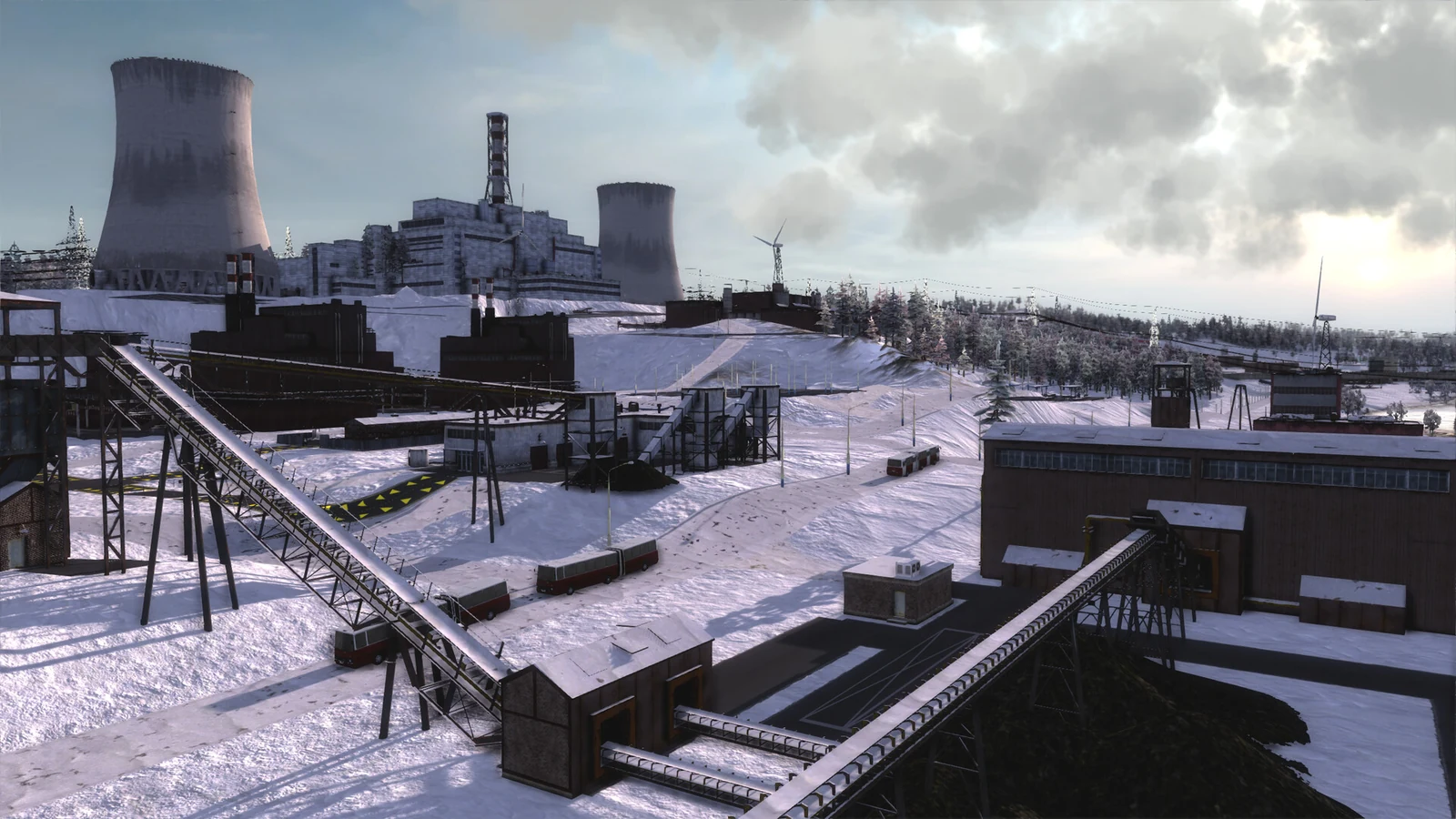

Production buildings are the farms, mines, factories and workshops that turn raw materials into the food, building materials and goods your republic runs on. In Workers & Resources: Soviet Republic, you place them, staff them with citizens and link them so one building's output becomes the next one's input. When that chain works, your city can feed its people, build new homes and keep its shops stocked. Knowing how these buildings depend on each other is the key to a city that doesn't stall.
Industry
Farming
Livestock farm
- Industry
- Farming
- Area
- -
- Workers
- 50
- Inputs per day
- 20 t crops
- Outputs per day
- 10 t livestock
- Power
- 3 MWh/day
- Water
- 14.3 m³/day
- DLC
- Base game
Small field
- Industry
- Farming
- Area
- 0.36 ha
- Workers
- -
- Inputs per day
- -
- Outputs per day
- 0.09 t crops
- Power
- -
- Water
- -
- DLC
- Base game
Medium field
- Industry
- Farming
- Area
- 1.57 ha
- Workers
- -
- Inputs per day
- -
- Outputs per day
- 0.274 t crops
- Power
- -
- Water
- -
- DLC
- Base game
Big field
- Industry
- Farming
- Area
- 4.81 ha
- Outputs per day
- 0.822 t crops
- DLC
- Base game
Industry
Food and consumer goods
Food factory
- Industry
- Food and consumer goods
- Workers
- 170
- Inputs per day
- 42 t crops
- Outputs per day
- 20 t food
- Power
- 7.6 MWh/day
- Water
- 3.4 m³/day
- DLC
- Base game
Distillery
- Industry
- Food and consumer goods
- Workers
- 100
- Inputs per day
- 30 t crops
- Outputs per day
- 6 t alcohol
- Power
- 13 MWh/day
- Water
- 2 m³/day
- DLC
- Base game
Fabric factory
- Industry
- Food and consumer goods
- Workers
- 100
- Inputs per day
- 20 t crops; 0.5 t chemicals
- Outputs per day
- 5 t fabric
- Power
- -
- Water
- -
- DLC
- Base game
Clothing factory
- Industry
- Food and consumer goods
- Workers
- 80
- Inputs per day
- 2.4 t fabric
- Outputs per day
- 1.2 t clothes
- DLC
- Base game
Slaughterhouse
- Industry
- Food and consumer goods
- Workers
- 50
- Inputs per day
- -
- Outputs per day
- -
- DLC
- Base game
Old food factory
- Industry
- Food and consumer goods
- Workers
- -
- Inputs per day
- -
- Outputs per day
- -
- DLC
- Early Start
Old distillery
- Industry
- Food and consumer goods
- DLC
- Early Start
Small food factory
- Industry
- Food and consumer goods
- DLC
- Early Start
Small distillery
- Industry
- Food and consumer goods
- DLC
- Early Start
Old clothing factory
- Industry
- Food and consumer goods
Industry
Construction materials
Woodcutting post
- Industry
- Construction materials
- Workers
- 30
- Inputs per day
- -
- Outputs per day
- 189 t wood
- Power
- -
- DLC
- Base game
Sawmill
- Industry
- Construction materials
- Workers
- 20
- Inputs per day
- 180 t wood
- Outputs per day
- 140 t boards
- Power
- -
- DLC
- Base game
Gravel quarry (40 workers)
- Industry
- Construction materials
- Workers
- 40
- Inputs per day
- -
- Outputs per day
- 140 t quarried stone
- Power
- 9.8 MWh/day
- DLC
- Base game
Gravel quarry (100 workers)
- Industry
- Construction materials
- Workers
- 100
- Inputs per day
- -
- Outputs per day
- 350 t quarried stone
- Power
- 23 MWh/day
- Water
- -
- DLC
- Base game
Gravel processing plant
- Industry
- Construction materials
- Workers
- 15
- Inputs per day
- 120 t quarried stone
- Outputs per day
- 82 t gravel
- Power
- 24 MWh/day
- Water
- 0.3 m³/day
- DLC
- Base game
Small gravel processing plant
- Industry
- Construction materials
- Workers
- 5
- Inputs per day
- 40 t quarried stone
- Outputs per day
- 27 t gravel
- Power
- 9.2 MWh/day
- Water
- 0.1 m³/day
- DLC
- Base game
Cement plant
- Industry
- Construction materials
- Workers
- 30
- Inputs per day
- 22 t coal; 210 t gravel
- Outputs per day
- 81 t cement
- Power
- 6.9 MWh/day
- Water
- 0.6 m³/day
- DLC
- Base game
Large cement plant
- Industry
- Construction materials
- Workers
- 40
- Inputs per day
- 28 t coal; 240 t gravel
- Outputs per day
- 108 t cement
- Power
- 6.3 MWh/day
- Water
- 0.8 m³/day
- DLC
- Base game
Concrete plant
- Industry
- Construction materials
- Workers
- 5
- Inputs per day
- 135 t gravel; 30 t cement
- Outputs per day
- 175 t concrete
- Power
- 15 MWh/day
- Water
- 85.1 m³/day
- DLC
- Base game
Prefab panels factory
- Industry
- Construction materials
- Workers
- 65
- Inputs per day
- 33 t cement; 65 t gravel
- Outputs per day
- 71 t prefab panels
- Power
- 8 MWh/day
- Water
- 1.3 m³/day
- DLC
- Base game
Asphalt plant
- Industry
- Construction materials
- Workers
- 5
- Inputs per day
- 20 t bitumen; 125 t gravel
- Outputs per day
- 145 t asphalt
- Power
- 18 MWh/day
- Water
- 0.1 m³/day
- DLC
- Base game
Brick factory
- Industry
- Construction materials
- Workers
- 75
- Inputs per day
- 33 t coal
- Outputs per day
- 51 t bricks
- Power
- 3 MWh/day
- Water
- 1.5 m³/day
- DLC
- Base game
Explosives factory
- Industry
- Construction materials
- Workers
- 75
- Inputs per day
- 0.75 t chemicals; 2.6 t gravel
- Outputs per day
- 1.2 t explosives
- DLC
- Base game
Small brick factory
- Industry
- Construction materials
- Workers
- -
- Inputs per day
- -
- Outputs per day
- -
- DLC
- -
Industry
Chemicals and oil
Chemical plant
- Industry
- Chemicals and oil
- Workers
- 60
- Inputs per day
- 0.72 t gravel; 0.84 t wood; 0.78 t crops; 1.2 t oil
- Outputs per day
- 0.81 t chemicals
- Power
- 25 MWh/day
- Water
- 11.2 m³/day
- DLC
- Base game
Large chemical plant
- Industry
- Chemicals and oil
- Workers
- 700
- Inputs per day
- 8.4 t gravel; 9.8 t wood; 9.1 t crops; 14 t oil
- Outputs per day
- 9.4 t chemicals
- Power
- 197 MWh/day
- Water
- 133 m³/day
- DLC
- Base game
Pumpjack
- Industry
- Chemicals and oil
- Workers
- -
- Inputs per day
- -
- Outputs per day
- 7 t oil
- Power
- -
- Water
- -
- DLC
- Base game
Oil refinery
- Industry
- Chemicals and oil
- Workers
- 500
- Inputs per day
- 250 t oil
- Outputs per day
- 125 t fuel; 75 t bitumen
- DLC
- Base game
Plastics factory
- Industry
- Chemicals and oil
- Workers
- -
- Inputs per day
- 27 t oil; 2.97 t chemicals
- Outputs per day
- 6.6 t plastics
- DLC
- Base game
Industry
Mining and metal
Coal mine
- Industry
- Mining and metal
- Workers
- 220
- Inputs per day
- -
- Outputs per day
- 924 t coal ore
- Power
- 9.2 MWh/day
- Water
- 4.4 m³/day
- DLC
- Base game
Coal ore processing plant
- Industry
- Mining and metal
- Workers
- 15
- Inputs per day
- 210 t coal ore
- Outputs per day
- 120 t coal
- Power
- 15 MWh/day
- Water
- -
- DLC
- Base game
Iron mine
- Industry
- Mining and metal
- Workers
- 250
- Inputs per day
- -
- Outputs per day
- 1,000 t iron ore
- Power
- 11 MWh/day
- Water
- 5 m³/day
- DLC
- Base game
Iron ore processing plant
- Industry
- Mining and metal
- Workers
- 15
- Inputs per day
- 225 t iron ore
- Outputs per day
- 105 t iron
- Power
- 17 MWh/day
- Water
- 0.3 m³/day
- DLC
- Base game
Steel mill
- Industry
- Mining and metal
- Workers
- 500
- Inputs per day
- 200 t iron; 357 t coal
- Outputs per day
- 43 t steel
- Power
- 48 MWh/day
- Water
- 10 m³/day
- DLC
- Base game
Mechanical components factory
- Industry
- Mining and metal
- Workers
- -
- Inputs per day
- 22 t steel
- Outputs per day
- 15 t mechanical components
- Power
- -
- Water
- -
- DLC
- Base game
Alumina plant
- Industry
- Mining and metal
- Workers
- 370
- Inputs per day
- 77 t bauxite; 2.6 t chemicals
- Outputs per day
- 33 t aluminium oxide
- DLC
- Base game
Bauxite mine
- Industry
- Mining and metal
- Workers
- -
- Inputs per day
- -
- Outputs per day
- Raw bauxite
- DLC
- Base game
Bauxite processing plant
- Industry
- Mining and metal
- Workers
- 15
- Inputs per day
- 125 t raw bauxite
- Outputs per day
- 75 t bauxite
- DLC
- Base game
Aluminium plant
- Industry
- Mining and metal
- Workers
- 370
- Inputs per day
- 52 t aluminium oxide; 2.5 t chemicals
- Outputs per day
- 30 t aluminium
- DLC
- Base game
Electronic components factory
- Industry
- Mining and metal
- Workers
- 150
- Inputs per day
- 1.5 t plastics; 1.5 t steel; 1.2 t chemicals
- Outputs per day
- 3.75 t electro components
- DLC
- Base game
Electronics assembly hall
- Industry
- Mining and metal
- Workers
- 150
- Inputs per day
- 1.5 t electro components; 2.25 t plastics; 1.5 t mechanical components
- Outputs per day
- 4.5 t electronics
- DLC
- Base game
Small coal mine
- Industry
- Mining and metal
Small iron mine
- Industry
- Mining and metal
Industry
Nuclear
Uranium processing plant
- Industry
- Nuclear
- Inputs per day
- 36 t uranium ore
- Outputs per day
- 1.7 t uranium oxide
- DLC
- Base game
Uranium conversion plant
- Industry
- Nuclear
- Inputs per day
- 2 t uranium oxide; 0.21 t chemicals
- Outputs per day
- 0.96 t UF6
- DLC
- Base game
Nuclear fuel fabrication
- Industry
- Nuclear
- Inputs per day
- 0.4 t UF6; 0.75 t chemicals
- Outputs per day
- 0.095 t nuclear fuel
- DLC
- Base game
Uranium mine
- Industry
- Nuclear
- Workers
- 100
- Outputs per day
- 75 t uranium ore
- DLC
- Base game
How production buildings work
Most production buildings take something in and turn it into something else. A coal mine digs out coal ore, a processing plant turns that ore into usable coal, and a steel mill combines coal with iron to make steel. Goods usually move down a chain like this, so the output of one building becomes the input of the next.
The daily output figures for these buildings assume full staffing and a steady supply of inputs. When one input runs short, the building slows down, and everything further along the chain waits.
Moving goods is the part that trips up a lot of builds. Storage buildings don't move anything on their own, so a factory can fill a warehouse next to it, but the goods only travel further if a truck, a forklift or a short factory connection carries them on. Long conveyor belts and pipelines need engines or pumping stations along the way, or the goods stop partway. Some goods have their own rules too: concrete and asphalt can't be stockpiled, so their plants send them out by truck as they're made, while cement can wait in silos.
Where raw materials come from
Mines and quarries pull resources out of the ground, and how much they produce depends on the quality of the deposit you place them on. The same mine can give very different results depending on where it sits, so check the placement overlay before you commit to a build. Coal, iron, bauxite and uranium mines all produce raw ore that still has to go to a processing plant, and there are smaller coal and iron mines too.
Quarries work a little differently. A gravel quarry digs quarried stone for a gravel processing plant, but its storage is small and only one truck can load at a time, so it runs in bursts and often sits idle. Put the gravel processing plant close by, and don't run more than about two dumpers per quarry.
Woodcutting posts are placed over trees, and their workers cut the trees into wood for trucks to haul to a sawmill, where it becomes boards. Nothing gets cut until workers arrive. Pumpjacks pull crude oil from an oil deposit, and that oil feeds the oil refinery and the plants that make chemicals and plastics.
How farming feeds food production buildings
Fields grow the crops that food, alcohol, fabric and livestock buildings depend on. They need no workers, since vehicles sow and harvest them. The farm is the building that holds those vehicles, along with fuel and fertiliser stores, and the number of vehicles it can park sets how many fields it can run.
Farms come in small, medium and large sizes, with room for 6, 12 and 30 vehicles. Fields come in the same three sizes, and a big field gives roughly 300 tonnes of crops per harvest at full fertility. A small field gives more crops per hectare, so it's the better pick when land is tight.
Seasons change the picture. With the seasons setting on, each field is sown in spring and harvested once in autumn, so the daily figures are an average over the year. New fields start at about 70% fertility and recover slowly on their own, and fertiliser speeds that up. Tractors and harvesters burn fuel from the farm's store, and if it runs dry, the harvest stops mid-season.
Crops then go to the buildings that use them. A food factory uses about 42 tonnes of crops a day, a distillery about 30, and a fabric factory uses crops together with chemicals. A livestock farm turns 20 tonnes of crops into 10 tonnes of livestock, and a slaughterhouse turns livestock into meat for shops. A food factory running full time needs dozens of big fields, so start with a few and add more only while the harvest still finishes on time.
How to build production buildings
There are two ways to get a production building built, and you pick the route for each construction site. The first is to fund it with Rubles or Dollars. The building appears finished almost straight away, but you pay the resource price plus a delivery fee that rises with distance from the nearest Customs House. It's quick and convenient, but it costs more.
The second is to build from resources. The site goes to a Construction Office, which sends vehicles to fetch materials from the buildings you've named as sources, and sends workers from a public transport station. This is the cheaper route, and it's the only one available in Realistic mode.
The Construction Office matters most early on, so it's worth setting up with care. You choose a search radius of under 1000, 2000 or 3000 metres, and which jobs it takes, such as roads, buildings, footpaths, conveyors and pipelines, factory connections and electric wiring. Turn off the jobs you don't want, because otherwise it will spend trips on them.
Sources are where most people get stuck. The office has no storage of its own, so every material has to come from a building you've named. Gravel comes from an aggregate storage or truck loading station, asphalt from an asphalt plant, concrete from a concrete plant, and steel, bricks, prefab panels and boards from open storage. Mechanical and electro components come from a warehouse, and if a material has no named source, nothing moves for it.
What unlocks production buildings
Research is an optional game setting, and it's carried out at the Technical University, the Medical University or the Headquarters of the Communist Party. Many production buildings stay locked until you finish the right project, and each project costs workdays to complete. For example, you can't build a steel mill until you've finished steel production, which itself follows from metallurgy study.
Other common gates work the same way. Engineering unlocks the mechanical components factory, Chemistry unlocks the chemical plant, and the bitumen study unlocks the asphalt plant. The oil refinery needs the fuel study followed by the refinery project, and the prefab panels factory waits on prefab panels construction.
Deposits stay hidden until you research geology. Coal, iron and oil deposits only appear on the minimap after the geological map research, unless research was switched off when you started. The nuclear buildings sit at the far end of a long path that begins with uranium mining, and modern nuclear production buildings also need the modern industry research. Plan ahead, since some of these projects take a long time.
Which production buildings matter most early on
Gravel sits at the base of most construction materials, feeding cement, concrete, asphalt, prefab panels and explosives. It's also cheap to import, and it's worth so little that importing it is often better use of your starting money, even though building a gravel industry looks like the obvious first move. Once you do commit to one, build more capacity than you think you need, because everything else leans on it.
Coal is the bottleneck people don't see. A steel mill uses a huge amount of coal and iron, and bricks, cement and power plants all draw on coal too, so plan the coal supply before you plan the steel. Asphalt is another surprise. An asphalt plant needs bitumen, bitumen comes from the oil refinery, and that refinery needs 500 workers and a steady oil supply, so import bitumen until the refinery is running.
Most early materials are cheap to import, while the expensive ones have long chains or need hundreds of workers, so import what's cheap and produce what's bulky. Crops feed the food factory, distillery and fabric factory, and citizens need food, meat and alcohol. Build the brick factory, the cement plant and the concrete plant in that order, since each needs bricks or cement to build and your first ones come in through the Customs House.
What production buildings need to run
Citizens are the only real labour supply, and they won't travel far for a job. They look for work within about 400 metres of home, and they won't stay in a single vehicle for more than four hours. If someone waits more than an hour at a stop with no vehicle, they head home and count as unemployed until the next shift.
That's why placement matters. Clean workplaces, such as food and clothing factories, work best near housing, while polluting plants like the brick factory, cement plant, steel mill and chemical plant belong further out. Just make sure a bus or train can still get workers there and back within four hours.
Power only comes into play if energy management is turned on in the game settings, and when it is, many production buildings need it every day. Substations reach buildings within about 325 metres, so you'll plan roughly one every 300 metres. The steel mill and aluminium plant connect straight to a high-voltage line instead of a substation.
Water is just as important. The food factory needs water at 97% quality or better, the distillery needs 95%, and a livestock farm needs 97% for its workers and 93% for its animals. The concrete plant uses a lot of water too. Ignore water quality and the plants stop.
Heat is the one people often forget. Factories and apartments both need a heat connection, and a city with power but no heat loses happiness in winter and stops producing.
FAQ
Why has my production building stopped?
Start with the output, because a full store can stop a building as surely as a missing input. A steel mill, for example, holds only about 150 tonnes of steel inside, so unless open storage is attached, finished steel backs up and the mill stalls. Once output is moving again, check the inputs, since a gap further up the chain stops everything in the same way.
How long does it take to build a production building?
Build time is counted in workdays, which is what one worker adds in a full day, so more workers on site shorten the job. The gravel quarry is the cheapest real build in the game at about 81 workdays, while a steel mill takes thousands. Excavators, bulldozers, asphalt pavers and rollers can add workdays without anyone on site, and cranes speed a job up without replacing workers.
Do I need the Early Start DLC for the old food factory?
Yes. The old food factory, the old distillery, the small food factory and the small distillery all come with the Early Start DLC. Most of the other production buildings are part of the base game, so they don't need it.
Can I sell what my production buildings make?
Yes. Goods your buildings make can be exported through a Customs House, paid in Rubles on the Soviet side and in Dollars on the Western side, once your supply lines are steady enough to spare them.