

To breed villagers in Minecraft, you need two adult villagers, enough food to make each one willing, and three beds: one for each parent and one for the baby. Each bed needs two empty blocks above it, and the mob griefing game rule has to be on so villagers can pick up food. The setup is the same on Java Edition and Bedrock Edition, with a few differences in the bed limit, the baby's look and nitwit babies.
| Requirement | What you need | Why it matters |
|---|---|---|
| Two adult villagers | Two grown villagers that can reach each other | A baby only comes from two adults |
| Food for each villager | 3 bread, or 12 carrots, potatoes or beetroots, or any mix that adds up to 12 food points | A villager has to be willing before it will breed |
| Three beds | Two for the parents and one free bed for the baby | Every villager, including the baby, needs its own bed |
| Two empty blocks above each bed | Nothing in the two spaces above the bed | The baby needs room to jump on the bed |
| A clear path to each bed | No slabs or trapdoors above the bed | Villagers treat those blocks as full blocks, which makes the bed unusable |
| Mob griefing on | Turned on with a game command | Villagers won't pick up food while the rule is off |
Build a Closed Room With Three Beds
Start with a closed room. Zombies and other hostile mobs attack villagers, and a zombie will either kill a villager or turn it into a zombie villager. A sealed room keeps both adults safe while they breed. If one does get turned, you can learn how to cure a zombie villager and bring it back. If the villagers are far away, a boat is an easy way to move them, since villagers can ride boats and minecarts.
Place the three beds inside the room and leave two empty blocks above each one. Babies need that space to jump on the bed, and a villager that wakes up on a bed with no room above it can suffocate. Each villager also has to be able to walk to its bed from where it stands, so keep the path open. A slab or trapdoor placed above a bed will make that bed unusable.
If you need to craft beds, each one takes 3 wool and 3 wooden planks. Fill the top row of a crafting table with the wool and the middle row with the planks.
Feed Both Villagers Until They Are Willing
A villager won't breed just because it's in the room. It has to be willing, which means the food it holds adds up to 12 points. Bread is worth 4 points, and carrots, potatoes and beetroots are worth 1 point each. Three loaves fill the same 12 points as twelve single vegetables, so bread takes fewer items to fill up a villager.
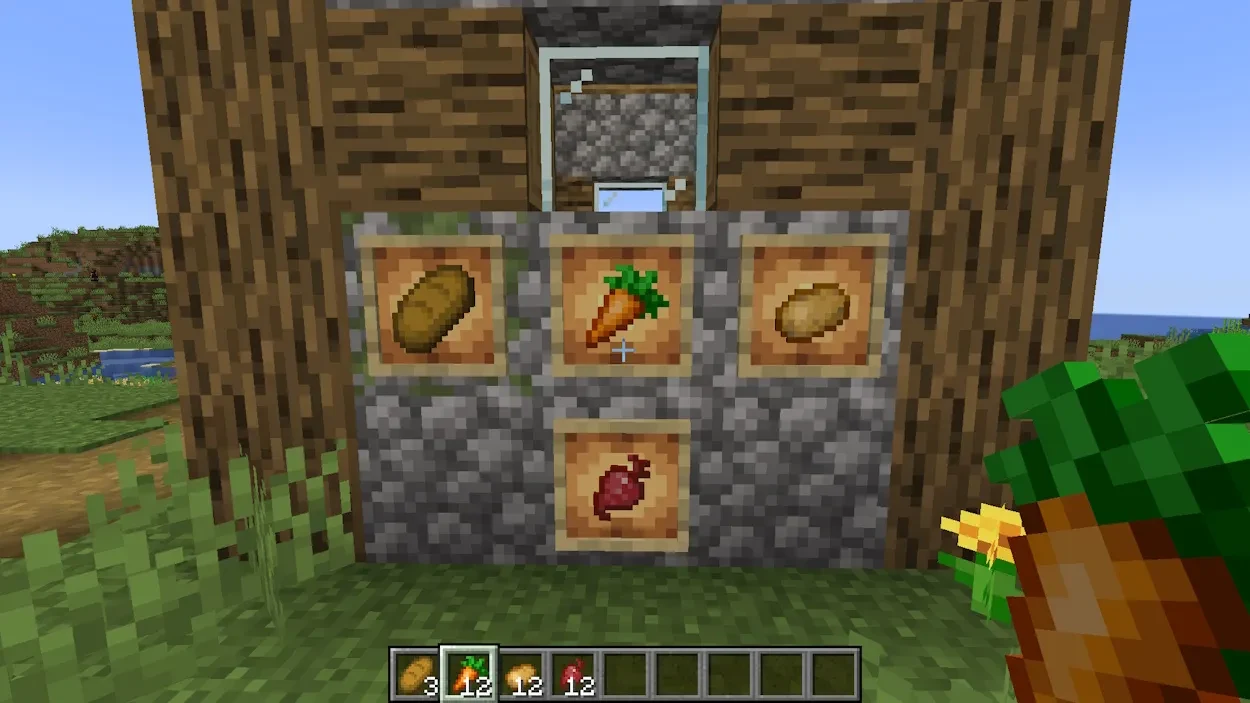
Throw the food at the villager itself. If it lands on the floor, a player standing nearby will grab it first. Villagers hold the food in their inventory and only eat it when they're about to breed, starting with the first slot and working forward until they reach 12 points.
Each breeding attempt uses up 12 points, even if no baby appears, so a villager needs fresh food for the next try. On Java Edition, food thrown at a sleeping villager wakes it up early.
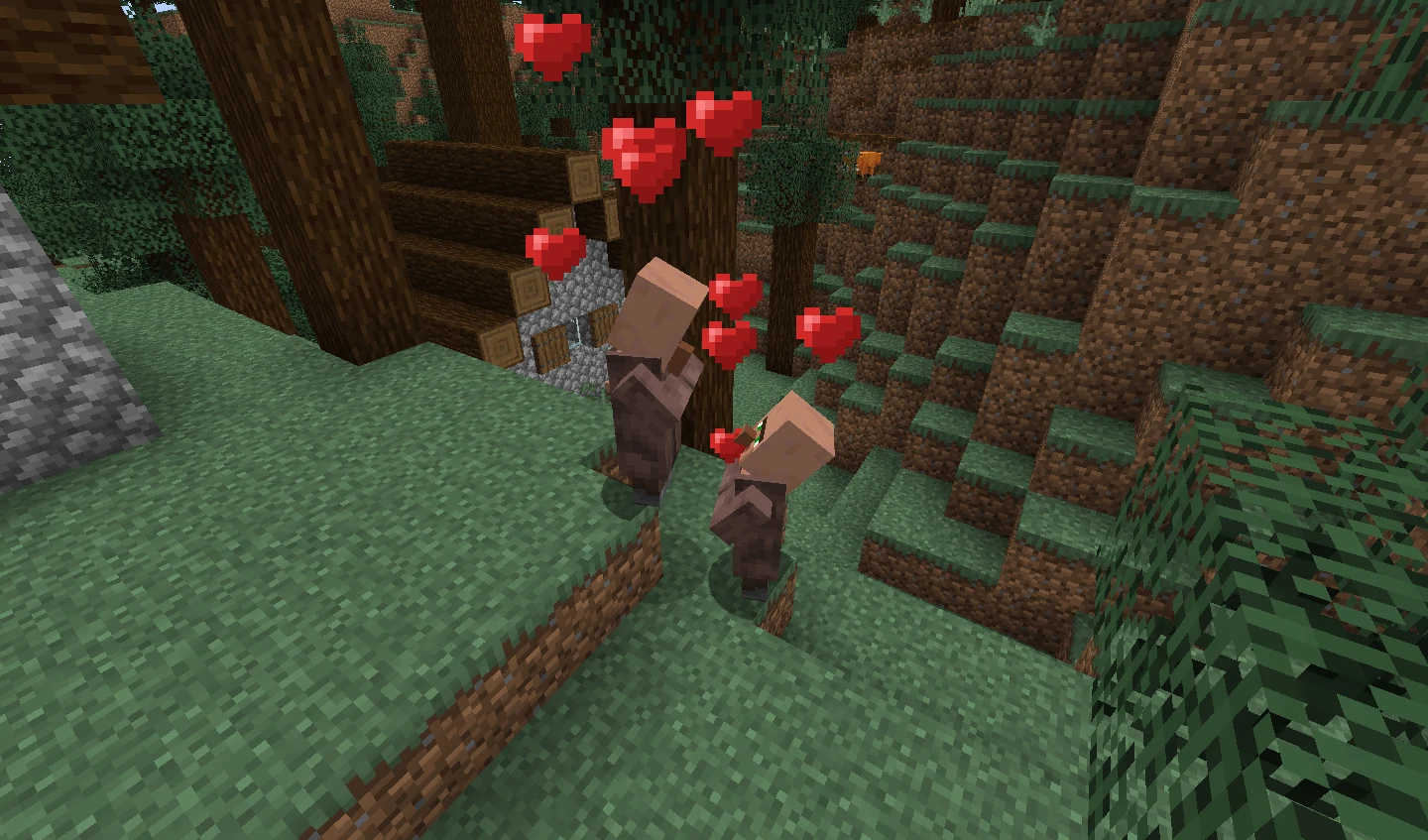
Turn On Mob Griefing So Villagers Can Take Food
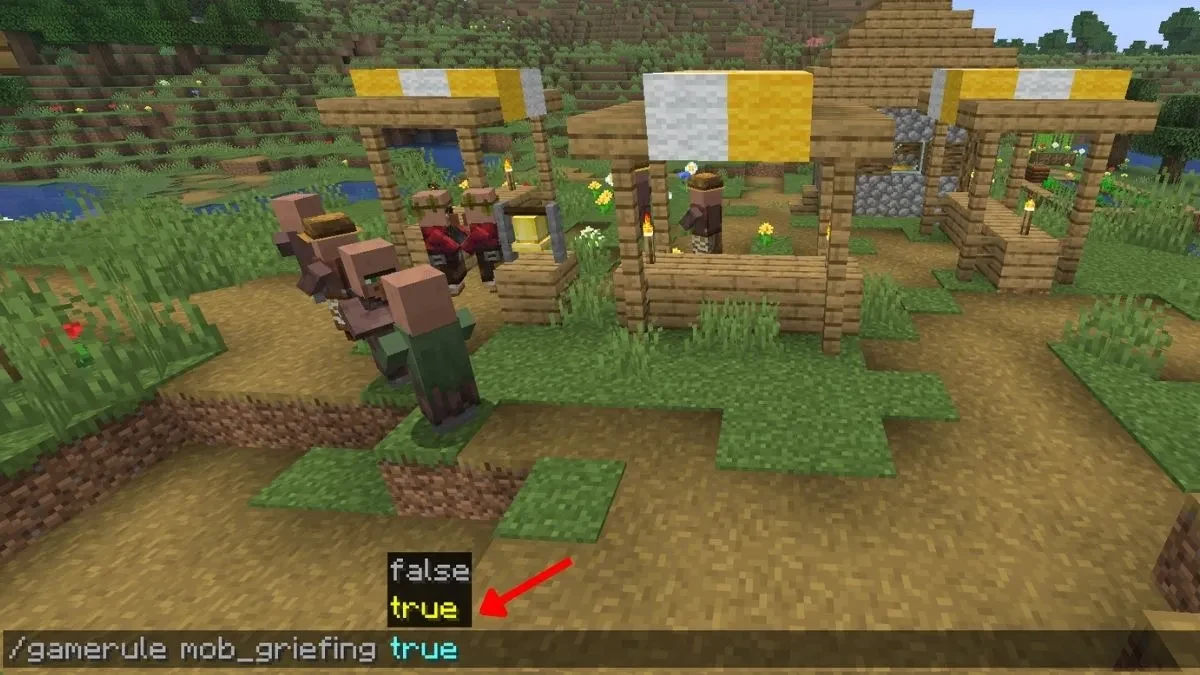
Mob griefing is a game rule, and for villagers it controls two things: whether they can pick up food and whether farmers can plant and harvest crops. With the rule off, villagers won't take food, so they never reach the 12 points they need. Turn it on before you start feeding them.
Commands have to be turned on in your world settings first. Then type the command for your edition in chat:
- Java Edition:
/gamerule mob_griefing true - Bedrock Edition:
/gamerule mobgriefing true
The Java name has an underscore and the Bedrock name doesn't, so copy the one that matches your edition exactly.
When Villagers Breed During the Day
Breeding follows the village's daily routine, so timing matters as much as food. Adult villagers gather late in the day around a bell, and willing villagers can breed when they meet there. Employed villagers don't breed with each other while they're working. Nitwits and unemployed villagers don't follow that rule, so they can breed with each other and with employed villagers who aren't working.
The gathering window differs by edition:
- Java Edition: 15:00 to 17:00 on the in-game clock (ticks 9000 to 11000)
- Bedrock Edition: 14:00 to 16:00 (ticks 8000 to 10000)
Both editions send villagers to bed at 18:00 (tick 12000). If you feed them during work hours, expect to wait until the gathering window.
What Happens After a Baby Villager Is Born
When a baby appears, the parents stop being willing for 5 minutes. After that, they need new food before they can breed again.
The baby needs a bed of its own too, so it claims one of your three beds, and all three are now taken. To keep breeding, add a fourth bed to the room or move the new baby out of it.
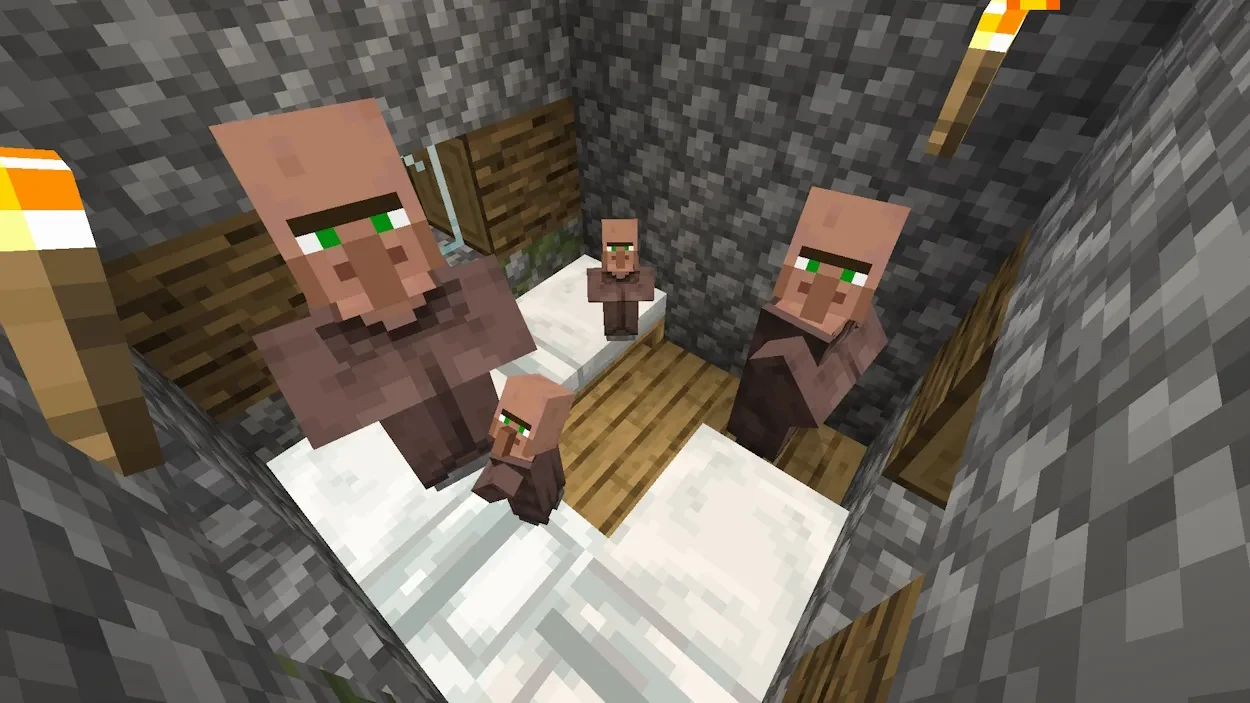
Babies are born unemployed. They grow into adults 20 minutes after birth, even while riding in a boat or minecart. Once grown, a villager can take a job if there's an unclaimed job site block nearby. To see the full set of jobs, browse all 15 villager professions in Minecraft Java Edition.
Why Villagers Still Won't Breed
If your villagers aren't breeding, check these first:
- No free bed: Every villager and baby needs its own bed. Add one or move an extra villager out.
- Blocked beds: Check the two spaces above each bed and the path to it.
- Not enough food: Each villager needs 12 points, and every attempt uses them up.
- Mob griefing off: Villagers can't pick up food until the rule is turned on.
- Cooldown: The parents need 5 minutes after a successful birth.
- Work hours: Employed villagers don't breed while they're working.
Java and Bedrock Differences
The basic setup is the same, but a few rules change between editions:
- Bed limit: On Java Edition, a parent needs an unclaimed bed it can reach within 48 blocks, with two empty blocks above it. The village's total population isn't counted. On Bedrock Edition, the game counts every villager inside the village boundary, and breeding stops once the village reaches its population cap. That cap is based on beds. The exact formula isn't known, so spare beds are the safe plan.
- Baby's look: On Java Edition, half the time a baby takes the look of the biome where it was bred. The other half, it takes the look of one parent's biome, with each parent equally likely. On Bedrock Edition, the biome where breeding happens sets the look.
- Nitwit babies: Nitwits can breed on both editions. On Java Edition, breeding can't produce a nitwit because of a known bug. On Bedrock Edition, each baby has a 10% chance to become a nitwit when it grows up.
Iron Golems in a Bigger Village
Villagers can summon iron golems to protect themselves, so a larger village may get some protection without extra work. On Java Edition, a golem can appear when five villagers gossip together or three panic together. The villagers involved need to have slept recently and must not have seen a golem nearby lately.
On Bedrock Edition, a village needs at least 10 villagers and 20 beds. Three quarters of its villagers must have worked in the last in-game day, not counting nitwits, and every villager must be linked to a bed. One more golem can spawn for each additional 10 villagers. The game checks about every 35 seconds, and the village has to be inside a player's simulation distance.