The reliable way to change a Digimon's personality in Digimon Story Time Stranger is DigiFarm training. Choose a Rank A or Rank B Training Set that moves your Digimon toward the personality you want, then keep training until the name changes. Each Rank A session takes 30 minutes.
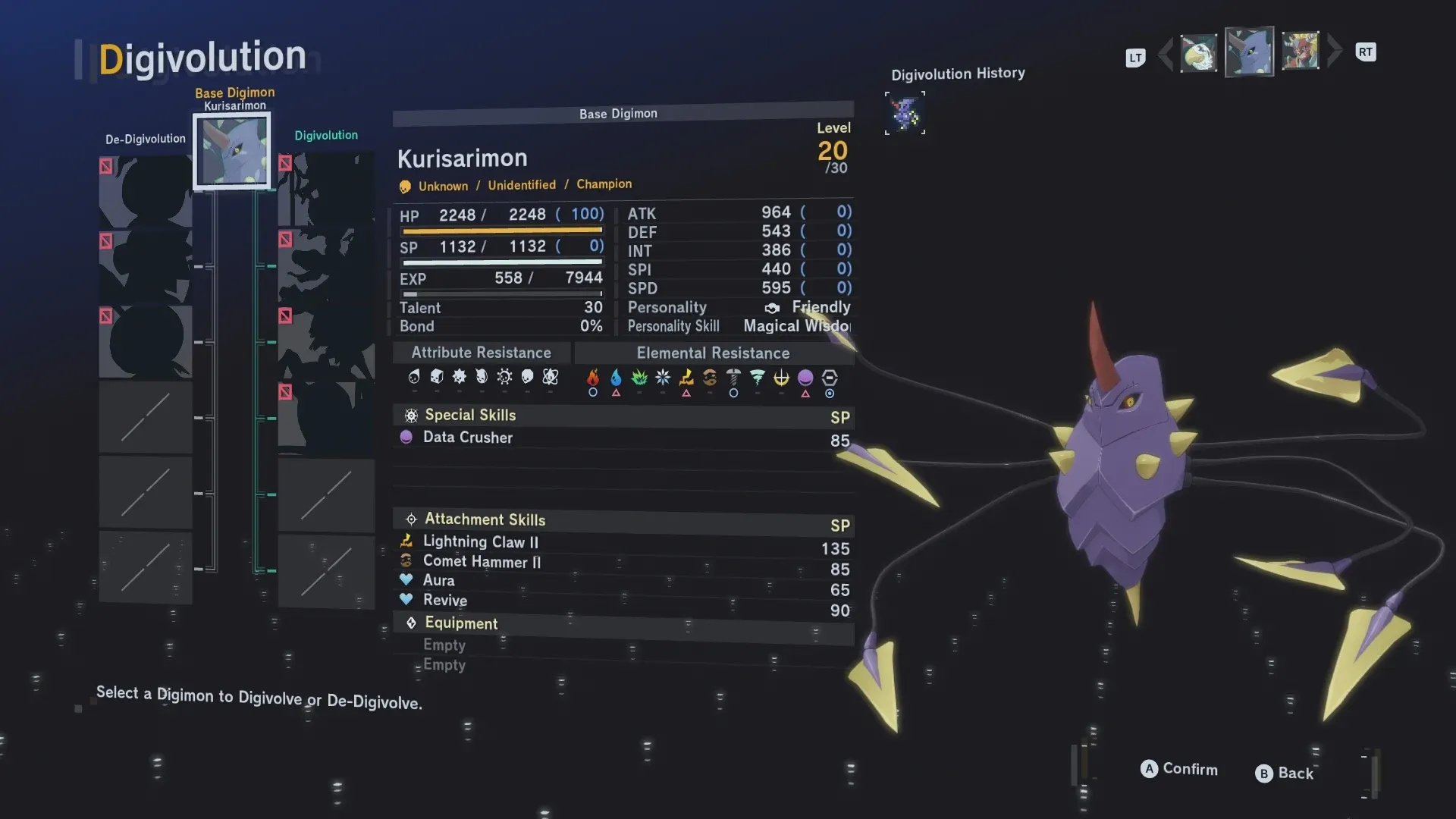
Each Digimon has one of 16 personalities, and it shapes how the Digimon grows, which Personality Skills it can use and whether it can reach certain Digivolutions. Talking to Digimon can also shift personality, but those results are harder to predict, so training is the better choice when you have a specific target.
| Training Set (Rank A) | Stat gain | Personality shift | Direction on the grid |
|---|---|---|---|
| Sauna A | HP +100 | Heart +10 | Right |
| Boombox A | SP +100 | Understanding +10 | Left |
| Punching Bag A | ATK +30 | Heart +10, Affection +10 | Right and up |
| Club A | DEF +30 | Heart +12, Companionship +8 | Right and down |
| Classroom A | INT +30 | Understanding +10, Companionship +10 | Left and down |
| Tearoom A | SPI +30 | Understanding +10, Affection +10 | Left and up |
| Treadmill A | SPD +30 | Heart +8, Companionship +12 | Right and down |
Each set boosts one stat and pushes the Digimon's hidden personality point in the direction shown. The numbers show how far the point moves in each direction, so Classroom A moves it 10 left and 10 down. Rank B sets push further in the same directions, so the Rank B Club set moves Heart by 25 and Companionship by 15. Rank C sets raise stats without shifting personality at all.
Reading the Digimon Story Time Stranger Personality Grid
Every Digimon's personality sits in one square of a grid with four columns and four rows. The 16 squares form four groups of four. Philanthropy fills the top-left quarter, Valor the top-right, Wisdom the bottom-left and Amicability the bottom-right. Read the columns left to right and the rows top to bottom:
| Column 1 | Column 2 | Column 3 | Column 4 | |
|---|---|---|---|---|
| Row 1 | Adoring | Devoted | Zealous | Brave |
| Row 2 | Tolerant | Overprotective | Reckless | Daring |
| Row 3 | Enlightened | Sly | Opportunistic | Friendly |
| Row 4 | Astute | Strategic | Sociable | Compassionate |
The four directions on the grid match the arrows on the training sets:
- Affection: up
- Heart: right
- Understanding: left
- Companionship: down
Moving a Digimon means moving its personality point along those directions until it lands in the square you want. The name you see is the square the point sits in, so a small nudge can move the point without changing the name. The label only changes when the point crosses into another square, which is why you should check the personality after each session rather than assume it changed.
Planning a Route to Your Target Personality
Plan the route before you spend any training time. Work through these three points:
- Find your Digimon's current square on the grid, then find the square you want.
- Count the moves: how many squares the target is to the left or right, and how many up or down.
- Match each move to a Training Set that points the same way. A set pointing the wrong way moves the point farther from your target.
Say you want to move a Daring Digimon to Astute. Daring sits in the second row on the right, and Astute sits in the bottom-left corner, so the route is two squares down and three squares left. Classroom A moves left and down, so using it twice covers both downward moves and two of the leftward ones. Boombox A moves only left, which covers the last step.
Keep in mind that each set points toward one or two directions rather than an exact named personality. Check the result after each session, and adjust your next set if the point lands somewhere you didn't expect.
Training at the DigiFarm to Change Personality
DigiFarm training is the controlled way to aim for a personality. It opens as you move through the main story, and you reach it at the In-Between Theatre. Once you're there, the process goes like this:
- Speak to the receptionist at the In-Between Theatre and choose "I wanna check out the Digifarm."
- Select the Digimon you want to train.
- Pick a Rank A or Rank B Training Set whose arrows point along your route.
- Look at the personality arrows in the preview, which show how the Digimon will shift before you confirm.
- Confirm the set and let the timer run.
- Collect the Digimon when training finishes, check its personality, and repeat with another set if it needs to move further.
A Digimon in training can't be used in battle until you collect it, so plan sessions around the team you need. The set stays in use until you collect the Digimon, and each completed timer cycle counts toward the result.
Feeding is also part of the DigiFarm, but it only raises bond and doesn't change personality. Training Sets are the tool that moves personality on the farm, and only Rank A and Rank B sets do it.
How Long Each Personality Training Cycle Takes
- Rank A: 30 minutes per cycle, shifts personality
- Rank B: 60 minutes per cycle, shifts personality further
- Rank C: 90 minutes per cycle, boosts stats only
The normal timer advances while the game is active, so training moves along as you play.
You can shorten the wait in two ways. Quick Complete Training finishes a session early for Yen, the in-game currency. A matching Crash Course Agent Skill halves training time for Digimon in its personality group.
The Daring to Astute route shows how the time adds up. Its three 30-minute cycles come to 90 minutes, and that's the full wait unless you use one of those shortcuts.
Changing Personality Through Dialogue and Digiline
Talking to Digimon is the slower, less predictable option. Active party Digimon show a speech-bubble icon above their heads when they have something to say, and you can answer their prompts in the field. Each dialogue choice carries an icon tied to one of the four groups: Heart for Philanthropy, Sun for Valor, Spectacles for Wisdom and Eye for Amicability. Choosing one nudges the Digimon toward that group and also raises bond.
Digiline messages can offer the same kinds of choices, including from Digimon in reserve or on the farm. Before you answer, check the Digimon's current personality, which is marked with a plus sign.
Prompts show up occasionally during play, and no set number of conversations is guaranteed to change a personality. Which answer helps depends on where the Digimon sits on the grid and which direction the prompt pushes. Check the personality after each answer, since a choice can move the hidden point without changing the name you see.
Choosing a Personality: Stat Growth, Skills and Digivolution
Each personality adds its own bonus growth every time the Digimon levels up. The table lists the bonus for all 16.
| Group | Personality | Growth per level-up |
|---|---|---|
| Philanthropy | Adoring | SPI +4, DEF +2 |
| Philanthropy | Devoted | SPI +3, INT +3 |
| Philanthropy | Tolerant | SPI +3, SP +4 |
| Philanthropy | Overprotective | SPI +3, HP +4 |
| Valor | Zealous | ATK +2, SPD +3 |
| Valor | Brave | ATK +3, SP +2 |
| Valor | Reckless | ATK +2, HP +4 |
| Valor | Daring | ATK +2, DEF +3 |
| Wisdom | Enlightened | INT +2, SP +4 |
| Wisdom | Sly | INT +2, HP +4 |
| Wisdom | Astute | INT +3, SPD +2 |
| Wisdom | Strategic | INT +2, SPI +3 |
| Amicability | Opportunistic | DEF +3, SPI +3 |
| Amicability | Friendly | DEF +3, ATK +3 |
| Amicability | Sociable | DEF +3, SP +4 |
| Amicability | Compassionate | DEF +4, HP +2 |
Each group suits a different role. Philanthropy fits healers, Valor fits physical and counter attackers, Wisdom fits magic attackers, and Amicability fits taunters, buffers and debuffers. Every Digimon also starts with a base personality when it is converted, and that personality isn't always the best fit for the build you want.
Personality also decides which Personality Skills are available. Each personality unlocks its own skills, which are passive effects that work in battle. A Digimon holds one at a time, and a new one replaces the old. A replaced skill can't be picked again until the Digimon's personality moves back to match it.
Digivolution is the other factor to check. Some Mega and DNA Digivolutions require particular personality values, so look at the target's listed requirement before you train. Checking first means you aim for the right square from the start, and since each change takes training time, it's worth deciding which stats and skills matter most before you begin.