

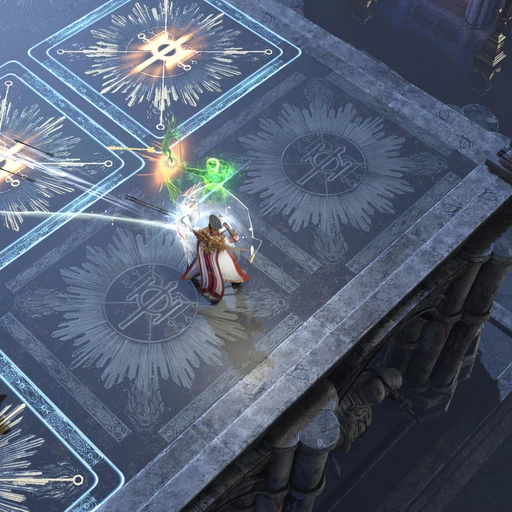
Path of Exile (PoE) is a free online action RPG set on Wraeclast, a dark fantasy continent where you play an Exile trying to build enough power to take revenge on those who wronged you. It's available on Windows, macOS, PlayStation 4 and 5, and Xbox One and Xbox Series X|S. You begin by picking one of seven classes: Duelist, Marauder, Ranger, Scion, Shadow, Templar or Witch. Your class sets where you start on the shared Passive Skill Tree and which Ascendancy specializations you can later take, though it doesn't lock you into one kind of skill.
Once you're in, the campaign takes you through ten acts across Wraeclast, and you loot gear and skill gems along the way. Skill gems give your character abilities, while support gems change those abilities when they're linked into the sockets of your equipment. Each level you gain also brings a Passive Skill Point to spend on the Passive Skill Tree, where small passives, Notables, Masteries, Keystones and Jewel Sockets branch out from your starting area. As you progress, the Labyrinth, a trap-filled dungeon, rewards Ascendancy points and unlocks your character's specialization.
After the campaign, the endgame opens on the Atlas of Worlds, a series of more than a hundred high-level maps that you enter with Map items to face harder bosses. Each map brings its own challenges and rewards, and finishing them earns points for the Atlas's own passive tree. Throughout the game, currency items such as Chaos Orbs and Divine Orbs can modify your gear, and they also serve as the main trade value between players.
- Developer
- Grinding Gear Games
- Publisher
- Grinding Gear Games
- Release
- Steam release: 2013-10-23
- Platforms
- Windows, macOS, PlayStation 4, PlayStation 5, Xbox One, Xbox Series X|S
Game data
Ascendancy Classes
Ascendancy Classes are specialist paths that each character picks after finishing the Normal Labyrinth. Every base class has its own set to choose from, and each one opens a separate passive tree that you build with Ascendancy points. Those points come from completing the four Labyrinths, and you can switch to a different class later by refunding your points and finishing a Labyrinth again.






Currency Items
Currency Items are the stackable items found in Path of Exile, including orbs, scrolls, shards, crystals and map tools that change gear, maps, gems, flasks and the Atlas. Most are used up when applied, and many are also traded between players. They are grouped by their main job, such as crafting, quality, map, Eldritch, Harvest and gem use.


Keystone Passives
Keystone Passives are powerful nodes on the passive skill tree that change a core rule of how a character works, such as how life, mana, or damage behaves. Each one's effect lines spell out what it changes, and those lines need to be weighed against the rest of the build. Players reach them by spending passive skill points along connected paths, and some are also granted by unique jewels. No single keystone suits every character, so the right choice depends on what the build is meant to do.






Pantheon Powers
Pantheon Powers are defensive powers in Path of Exile that you unlock by defeating named gods during the campaign. You can run one Major and one Minor power at a time, swapping them freely in any town or hideout, and each one protects against a different kind of danger. Upgrades come from Divine Vessels used on non-unique maps to make them Deified, where certain bosses drop the filled vessels that apply each upgrade.



Path of Exile Controls
| Action | Desktop |
|---|---|
| Move | Left mouse button |
| Default skill slot | Right mouse button |
| Skill slots | Q, W, E, R, T |
| Second skill bar | Ctrl+Q, Ctrl+W, Ctrl+E, Ctrl+R, Ctrl+T |
| Use flasks | 1 to 5 |
| Quest Log and World Map | U |
| Character Pane | C |
| Instance information (monster level) | Tab |
Path of Exile gameplay tips
- Put your main active skill gem in the item with the largest useful group of linked sockets, then link the supports that boost that skill. Supports only affect the skill they're linked to, so every link should work toward your main ability. Sockets start out white, and any gem fits any socket colour, with a matching colour adding 10% quality.
- Spend passive points along connected paths that support your main skill and your defences. Every point has to link back to your starting area, so plan the route before you commit. Read a Keystone's benefit and its drawback before you take it, since Keystones can change how a build works at its core.
- Complete the Labyrinth when your character is ready, then spend the Ascendancy points it gives you. The specialization's own passive tree is a major build choice, so don't leave those points sitting unspent.
- Keep Fire, Cold and Lightning resistance near the 75% cap, and recheck your gear as you move through the campaign. Anything above 75% adds no extra reduction, but the extra acts as a buffer when something lowers your resistance. Resistance penalties increase during the campaign, so gear that was enough earlier can fall short later.
- Compare the cost and likely result before spending a Chaos Orb or Divine Orb on an uncertain craft. Both are valuable, and an uncertain craft can use up one of them with no guarantee of the result you want.
- Use a Crafting Bench to add a missing modifier, such as life or resistance, when the item has room for one. Benches are in every town from Act 2 onward, so you can use one as soon as you reach that point in the campaign.